
Key Facts & Orbit
- Ryugu is a near-Earth object belonging to the Apollo group (i.e. its orbit crosses Earth’s orbit).
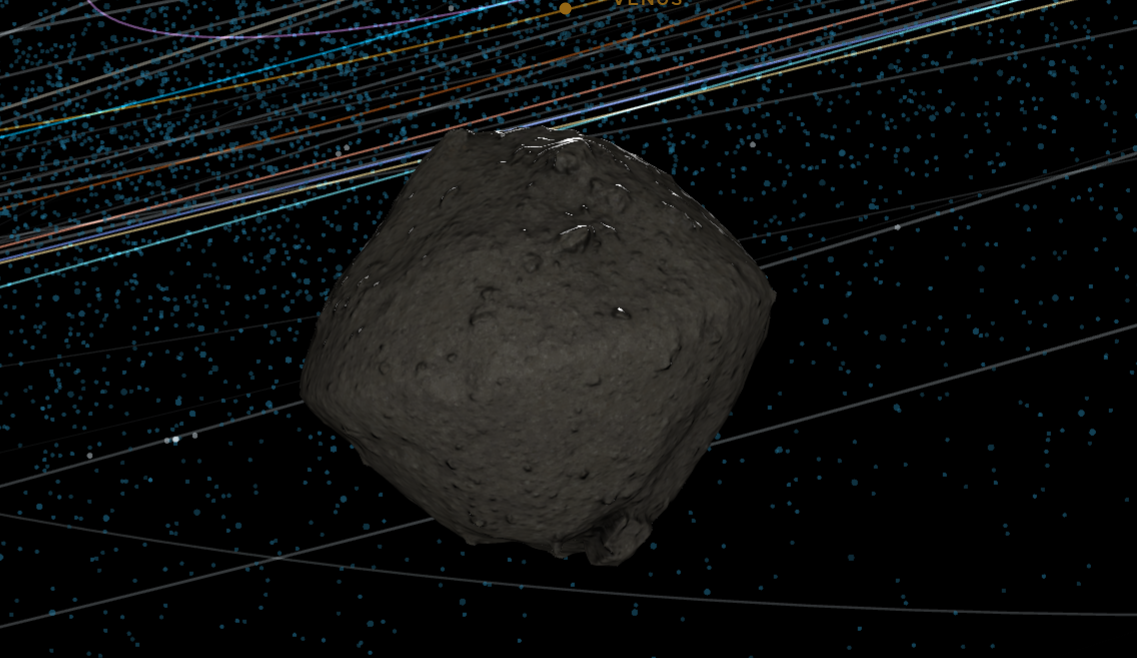
- Its approximate size (diameter) is ~ 0.9 km (some sources quote ~ 900 m) and it has a “spinning-top” or diamond shape including an equatorial ridge.
- Its spectral classification is C-type / carbonaceous (or Cg / carbonaceous variant), meaning it is relatively dark and carbon-rich.
- Ryugu is believed to be a rubble-pile asteroid (i.e. a loose aggregate of rock fragments held together by gravity and weak forces).
- Its rotation period is ~ 7.63 hours (some sources also discuss spin states and past spin evolution).
Sample Mission & Discoveries
- The JAXA Hayabusa2 mission (which has NASA partnerships in analysis) was launched December 3, 2014, and rendezvoused with Ryugu on June 27, 2018.
- Hayabusa2 made two touchdowns on the surface in 2019 (one for surface material, one to sample subsurface via an artificial crater) and returned a sample capsule to Earth December 6, 2020.
- The returned sample has been found to be organic-rich, containing various kinds of carbon compounds and hydrated minerals, supporting the idea that Ryugu contains primitive solar system materials.
- In polarimetric observations (ground-based), Ryugu has exhibited a very high degree of polarization (up to ~53 % at phase ~100°), implying large grains on its surface and relatively low multiple scattering.
- High-resolution imaging and LiDAR allowed detailed mapping of crater rims, and models suggest the east-west asymmetry of crater rims might be influenced by rotation dynamics (Coriolis / inertial effects) when surface speeds approach escape velocities locally.
- Some models suggest the equatorial ridge might have accreted from crater ejecta, over millions to billions of years, under rapid rotation.
Impact Risk & Trajectory
- Ryugu is classified as a potentially hazardous asteroid (PHA), though currently no high probability of Earth impact is predicted in the near future.
- Because of its orbit, Ryugu’s minimum orbital intersection distance (MOID) with Earth is small, making it one to watch, but current analyses do not indicate an imminent threat.
- A future close approach (e.g. in December 2076) is predicted, though still at distances that are not dangerous.
