

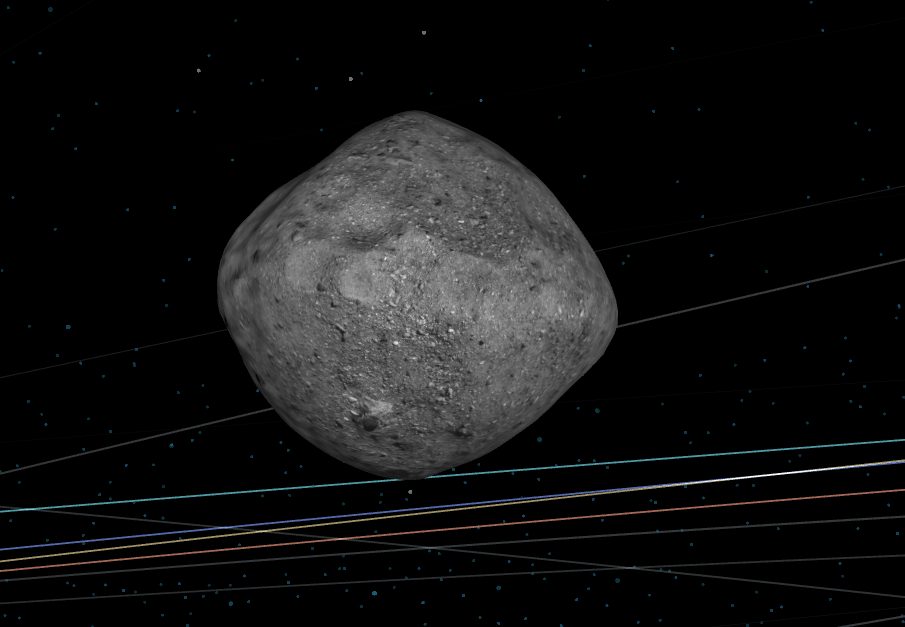
Key Facts & Mission
- Bennu is a carbonaceous (carbon-rich) near-Earth asteroid of the B-type / carbonaceous class. NASA describes it as relatively small and one that crosses near Earth periodically (~every 6 years).
- NASA’s OSIRIS-REx mission was the first U.S. mission to collect and return a sample from an asteroid. It launched in 2016, collected material on October 20, 2020, and delivered the sample to Earth on September 24, 2023.
- The returned sample (~120 g) has been undergoing laboratory analyses. Early results show a dark, fine-grained regolith, with inclusions, hydrated minerals (phyllosilicates), organics, sulfides, and rare Na-rich phosphates.
Impact probability & risk
- Bennu’s impact probability through the year 2300 is low, but nonzero. One estimate is 0.057 % (~1 in ~1,754) for the cumulative risk up to 2300, and specifically 0.037 % (1 in ~2,700) for impact on Sept 24, 2182.
- The OSIRIS-REx “TAG” (Touch-And-Go) sampling manoeuver had negligible effect on Bennu’s orbit; the trajectory changes due to sampling were much smaller than other forces (e.g. thermal forces, solar radiation).
- A particularly significant future flyby is in 2135. That close approach will alter Bennu’s trajectory by Earth’s gravity, making future predictions more uncertain.
Scientific value
- Because of its primitive (carbon-rich) composition, Bennu is a window into the early solar system — especially for volatile compounds, organic molecules, water-bearing minerals.
- The sample return allows scientists to calibrate remote observations, test how much space weathering and thermal effects alter asteroid surfaces, and to better understand how small forces (e.g. Yarkovsky effect) shift orbits over decades.
