
Key Facts & Orbit
- Itokawa is a near-Earth asteroid of the Apollo class (i.e. Earth-crossing).
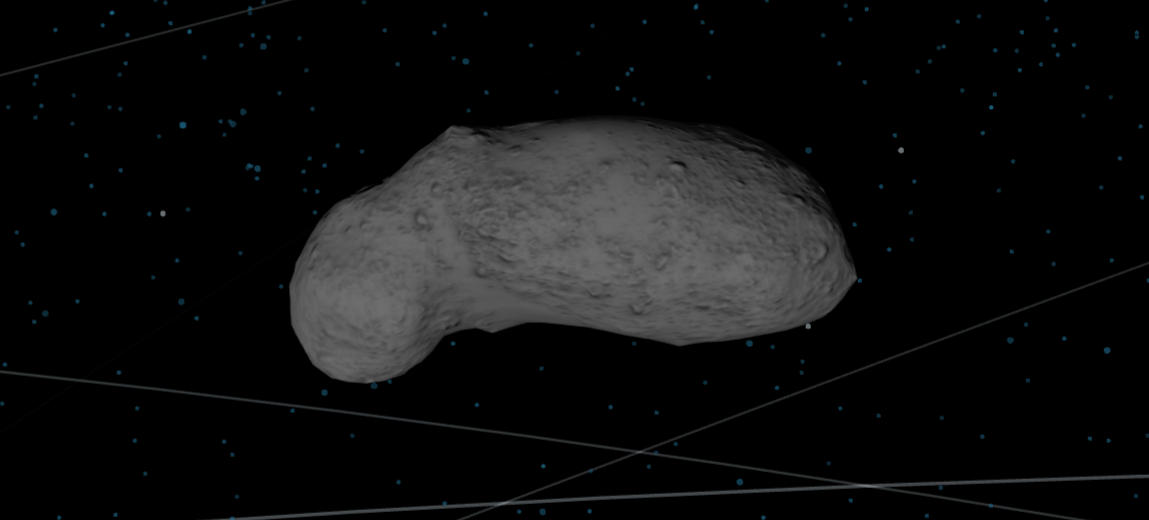
- Its dimensions are roughly 535 × 294 × 209 meters (i.e. a highly elongated, irregular shape).
- The surface is highly varied: some smooth “sea” regions, others rock-strewn, with a mixture of regolith and exposed boulders.
- The mean bulk density is estimated ~ 1.95 ± 0.14 g/cm³, lower than typical solid rock, suggesting internal porosity / voids.
- Its rotation period is about 12 hours 9 minutes (12.15 h) roughly.
- It is thought to have formed from fragments of a disrupted parent body; Itokawa may itself be a reaccumulated rubble body (i.e. not monolithic).
- Based on crater counts, geologic mapping, and sample analysis, Itokawa is thought to be ~4.5 billion years old in origin, but some internal disruption and reassembly may have occurred ~1.5 billion years ago.
Sample Mission & Discoveries
- Hayabusa (JAXA) was the first mission to return samples from an asteroid (target: Itokawa).
- Hayabusa arrived in 2005, made contact, collected small grains (≈1,500+ tiny particles), and returned to Earth in 2010.
- The returned particles (regolith grains) have been extensively studied to understand mineralogy, grain size, composition, space weathering effects, and surface processing.
- Comparative studies of Itokawa’s surface regions (smooth “Muses Sea” area vs rougher terrain) help understand regolith migration, particle sorting, seismic shaking, and microgravity surface processes.
Impact Risk & Trajectory
- Itokawa is not currently a significant impact risk; it is monitored, but no high probability impact is predicted in the near future. (No strong risk listing).
- Its orbit is well determined, and its Earth approaches are not dangerously close under current orbital projections.
