

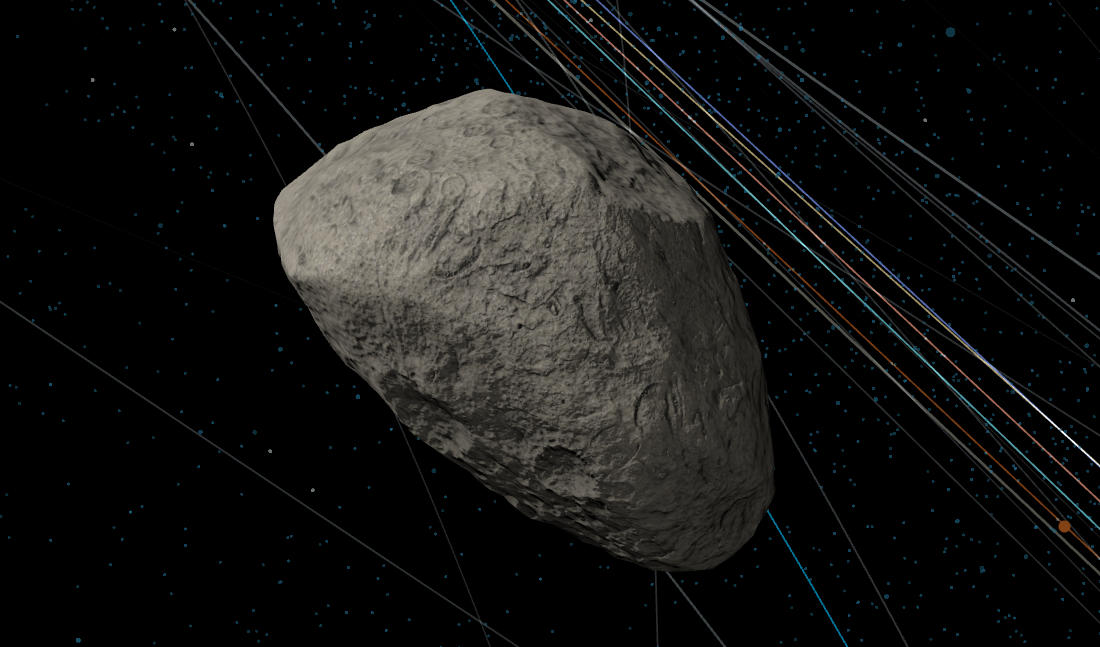
Key Facts & Orbit
- Apophis is classified as a “potentially hazardous asteroid” (PHA).
- Its diameter is estimated to be ~340 m (mean) with a longer axis perhaps ~450 m.
- It is an S-type (stony) asteroid.
- Its surface composition, from near-infrared spectroscopy, is consistent with LL chondrites (a subtype of stony meteorites), based on band parameters in the 2013 observation campaign.
Close approach in 2029 & risk assessment
- On April 13, 2029, Apophis is predicted to pass at about 20,000 miles (≈32,000 km) from Earth’s surface; closer than many geostationary satellites.
- Earlier on, when Apophis was first discovered, impact risk estimates were much higher. At one point, a 2.7 % chance of impact in 2029 was considered.
- But as more observations (optical + radar) accumulated, the risk was refined downward. Now NASA states there’s no chance of impact in 2029, or in at least 100 years.
- Because of this, Apophis has been removed from NASA’s “risk list” (i.e. no nonzero Torino / Sentry listing for foreseeable decades).
Scientific & mission interest
- The 2029 close pass is a rare opportunity to study how Earth’s gravity might perturb the asteroid: change its spin, cause seismic reshaping, or alter its surface.
- NASA has extended the OSIRIS-REx spacecraft mission into OSIRIS-APEX (Origins, Spectral Interpretation, Resource Identification, and Security — Apophis Explorer) to rendezvous with Apophis after the 2029 flyby. It will use the same suite of instruments that studied Bennu.
- OSIRIS-APEX may stir up dust or eject surface regolith to expose subsurface layers, allowing comparison of pre- vs post-flyby surface changes.
- Another mission concept under discussion is RAMSES (Rapid Apophis Mission for Security and Safety), aiming to reach Apophis before the 2029 close approach to make measurements of mass, gravity field, and spin changes.
